In March 2026 I signed off on an AI SEO tools budget for three client accounts that looked tidy on the quote. Then the AI add-on landed, the seats landed, and one platform’s invoice had quietly doubled by month two. That’s the line every roundup skips: the sticker price and the price you actually pay are different numbers. I now price these tools the way our finance lead does, because search engine volume is set to drop about 25% by 2026 as buyers shift to AI chatbots. That shift is where the new spend goes.
The ledger, up front: for most agencies the core pick is SE Ranking, because it folds SEO, AI-search visibility, and AI content into one platform with API and MCP in every plan, so one line item replaces several. The honest caveat: if all you need is content-brief grading, a specialist like Surfer or Clearscope grades deeper, and if you live in backlinks, Ahrefs’ index is bigger. Everything else, priced and tested, sits in the ledger below.
What I judged each on:
- True cost after the add-ons stack: the tier that actually turns the AI features on, plus seats.
- The job it does: core platform, content optimization, or AI-answer visibility.
- White-label, seats, and API/MCP for agency delivery across a client roster.
- AI-search (GEO) coverage: whether it tracks who the AI answers mention.
- Data you can trust in front of a client.
The method was plain: we ran each inside real client campaigns and logged the invoice, the seats, and the hours it saved or cost.

Table of Contents
What an AI SEO Tool Really Costs After the Add-Ons Stack Up
The honest cost picture: most AI features in these tools sit behind an add-on or a higher tier, so the sticker price is not the real price. One rule holds across every vendor. Price the tier that actually turns the AI features on, then add the seats your team needs.
Here’s where the ledger gets honest. A platform advertised as one figure can land at double once the AI layer switches on. Semrush parks its AI visibility work in a separate toolkit. Ahrefs prices its AI coverage as a heavy monthly climb. Then come the seats, and the overage charges when a client campaign burns through its prompt caps.
None of this is hypothetical spend. With nearly nine in ten organizations now using AI regularly, and marketing among the functions reporting the biggest gains, AI for SEO is now the line item your clients assume you already run.
The real starting cost column prices the AI-on tier, seats and all. That figure, not the headline, is what hits the P&L.
| Tool | Job it does | AI capability | Real starting cost (AI-on tier) | White-label / API + MCP |
|---|---|---|---|---|
| SE Ranking | Core all-in-one platform | AI rank + AI-search visibility, AI content, AI insights | $129/mo ($103.20/mo billed annually) | Yes (Agency Pack) / API + MCP every plan |
| Ahrefs | Core platform, backlink-led | Brand Radar AI-answer tracking | Higher tiers; all-in cost runs high | Limited / API |
| Semrush | Core platform, competitive data | AI Toolkit add-on | Core plan plus AI Toolkit add-on | Limited / API |
| Surfer SEO | Content optimization | SERP content scoring plus GEO tracker | From about $99/mo | No / API |
| Frase | Content briefs | AI briefs plus writer | From about $45/mo | No / API |
| Clearscope | Enterprise content grading | Content grading | From about $170/mo | Limited / API |
| NeuronWriter | Content optimization (low end) | SERP plus NLP recommendations | From about $19/mo | No / limited |
| Profound | AI-answer visibility (GEO) | AI-answer analytics, SOC 2 / SSO | From about $99/mo | Limited / API |
| Otterly.ai | AI search monitoring | Mentions and prompts across engines | From about $29/mo | Limited / API |
If You Run One Platform, Which One Earns the Seat?
For teams that want one line item instead of a stack, the all-in-one AI SEO platforms carry the whole job: classic SEO, AI-search visibility, and AI content under one login. This group covers SE Ranking, Ahrefs, and Semrush. The one-line verdict: SE Ranking is where we’d start.
1. SE Ranking
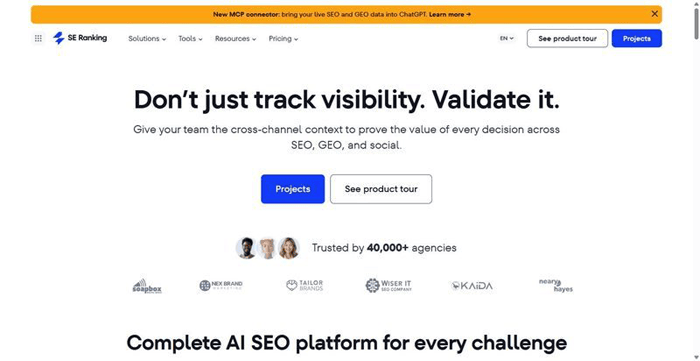
An AI-powered SEO platform for agencies and mid-market in-house teams that folds SEO, AI-search visibility, and AI content into a single line item.
Best for: agencies that want SEO, AI-search visibility, and AI content in one platform, with API and MCP in every plan.
Standout feature: It combines an AI Rank Tracker that also tracks AI prompt visibility across ChatGPT, Perplexity, AI Overviews, AI Mode and Gemini with AI-intent keyword research, Content Editor and AI Writer. AI Insights runs daily cannibalization and thin-content checks, and Report Builder ships AI summaries, all in one workspace, with API and MCP in every plan.
Pros:
- Covers classic SEO and AI-search visibility in the same workspace
- Builds AI content briefs and drafts them in-platform
- Delivers white-label client reporting through the Agency Pack
- Includes API and MCP access in every plan tier
Cons:
- AI output needs a human pass before it reaches a client
- Some Insights only work with a connected Google Search Console project
- The depth suits systematic multi-client work, not occasional use
Pricing: Core runs $129/mo ($103.20/mo billed annually) and Growth $279/mo ($223.20/mo billed annually). The AI Search add-on starts at $89/mo ($71.20/mo annually), scaling AI prompts and unlocking SE Visible for deeper AI-answer monitoring. API and MCP come with every plan, and a 14-day free trial is available.
My verdict: This is the line item that earns its seat for a multi-client agency. What it returns: rank tracking, AI-answer visibility, and content briefs off one monthly invoice, with white-label reporting built in. What it costs: the AI Search add-on once you need prompt volume at scale. One honest note: the AI drafts still need your editor.
2. Ahrefs
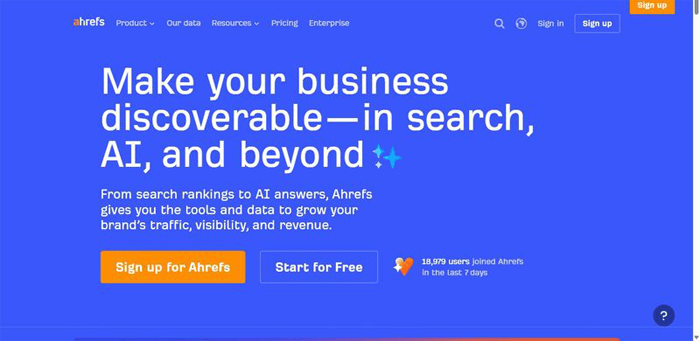
The backlink specialist that has grown an AI-answer layer without leaving its link-index roots behind.
Best for: backlink-led SEO teams adding an AI-answer visibility layer.
Standout feature: Brand Radar. It tracks how often a brand shows up inside AI answers, sitting on the backlink and keyword datasets Ahrefs is known for. For a link-led team, AI-visibility signals land beside the referring-domain views. No second login, no spreadsheet to reconcile.
Pros:
- Draws on one of the deepest backlink indexes going.
- Tracks brand presence across AI answers via Brand Radar.
- Bundles mature all-in-one research in one workspace.
Cons:
- Gates the AI-answer features to its higher tiers.
- Runs the total bill high once every AI engine is covered.
- Carries platform weight a content or GEO team won’t use.
Pricing: higher-end all-in cost at scale, with the AI-answer tooling living on the upper tiers.
My verdict: For a link-first shop this earns its place. When quarters are measured in placements and referring domains, the index does real work, and Brand Radar adds AI-answer signal. The autopsy: you buy the whole platform just to switch the AI features on, so a content or GEO team carries cost it never spends.
3. Semrush
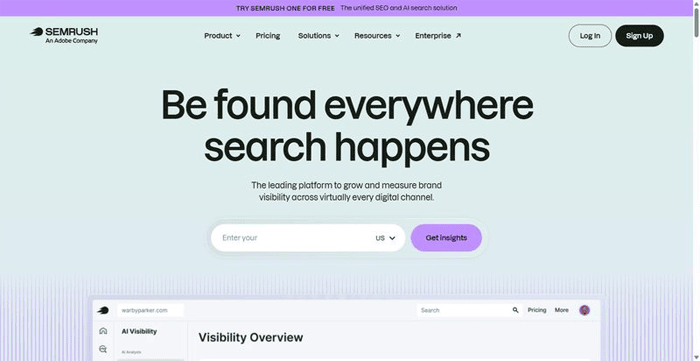
The market-intelligence heavyweight: broadest data suite in the category, AI visibility layer added on top.
Best for: teams that want the widest competitive and traffic dataset with an AI layer bolted on.
Standout feature: Its AI Toolkit add-on layers AI-answer visibility and AI content features onto a deep competitive, keyword, and traffic dataset. A team already reading those numbers every morning can extend into AI search from the same dashboard, no new login.
Pros:
- Covers the widest competitive and traffic dataset here.
- Adds AI-search visibility via the AI Toolkit.
- Reports with mature, client-ready dashboards.
Cons:
- Gates AI features behind a paid add-on, so true cost stacks.
- Runs heavier and pricier than content or GEO teams need.
Pricing: Core plan plus a separate AI Toolkit add-on; the total cost stacks.
Honest assessment: If your team already lives here for competitive intelligence, the AI Toolkit is the low-friction way to add AI-answer visibility. Come for AI search first and you’re buying a heavy suite for one layer. The ledger decides.
The Content Optimizers Worth Their Monthly Invoice
When you already run a platform and the bottleneck is briefs and on-page work, these content-layer tools earn a seat. This group covers Surfer, Frase, Clearscope, and NeuronWriter: each one lives in the draft, scoring and shaping pages against the SERP rather than trying to be the whole stack.
4. Surfer SEO
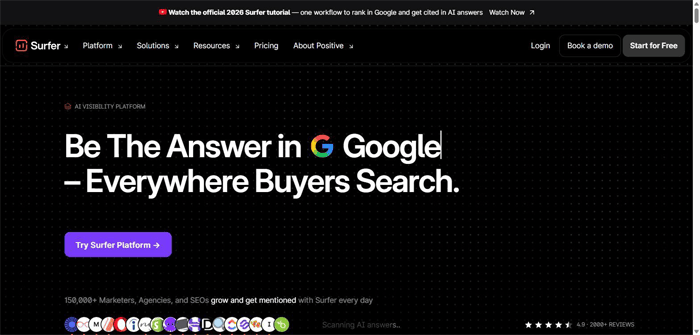
The write-and-optimize workhorse: it scores a draft against pages already ranking, so writers stop guessing.
Best for: content teams optimizing drafts against the live SERP.
Standout feature: Real-time SERP-driven content scoring paired with a GEO tracker. Writers optimize a draft against what currently ranks, then check whether the page appears in AI answers, all in one place. Fast enough to matter when a story is running warm.
Pros:
- Scores drafts against the live SERP.
- Adds a GEO tracker for AI-answer presence.
- Keeps pace with a writer.
Cons:
- Content layer only: no rank tracking or backlinks platform.
- Per-article and content limits add up across clients.
Pricing: From around $99/mo, with content-volume tiers above.
My verdict: strong as the writer’s optimization seat, weak beyond that. The ledger is simple: it earns its invoice when drafts are the bottleneck and you own rank and link tools elsewhere. Ask it to do more and you hit the ceiling.
5. Frase
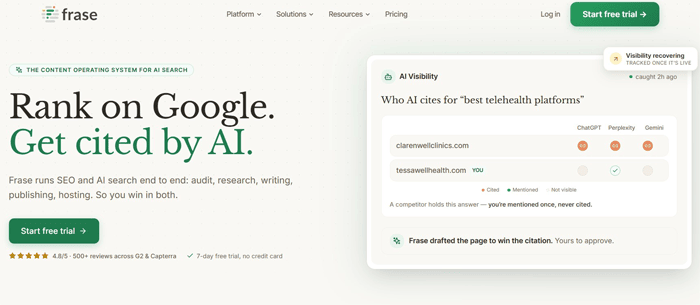
Frase turns a query into a working content brief fast, then adds an AI draft.
Best for: fast AI content briefs and outlines
Standout feature: It builds SERP-based briefs and outlines in minutes, then layers AI drafting on top, so a writer goes from a raw query to a structured, optimization-ready brief before the research slog usually ends. It also aggregates the questions searchers actually ask across the SERP, so each brief is shaped for answer-engine intent rather than keywords alone.
Pros:
- Generates SERP-based briefs quickly
- Integrates AI writing directly
- Keeps the workflow approachable
Cons:
- Lighter data depth than a full platform
- AI writing volume sits behind an add-on
Pricing: from roughly $45 to $115/mo.
My verdict: We ran Frase for a quarter and the ledger held: briefs that took an hour dropped to twenty minutes. The autopsy, depth thinned on competitive topics. A strong brief engine, not the whole desk.
6. Clearscope
The content grader that editorial teams reach for when every writer needs one shared standard.
Best for: enterprise content teams that want the cleanest content grading.
Standout feature: A polished, simple grading workflow that maps a draft to the terms and depth top pages cover, then scores it live. Editorial teams prize the clarity: every writer works one bar, so quality holds across a large pool without heavy editing.
Pros:
- Grades content reliably
- Scales across writer pools
- Fits editorial workflows
- Plugs grading into Google Docs and WordPress, with a content inventory view
Cons:
- Premium price
- No rank or backlink data
- Overkill if you already optimize
Pricing: premium; $170 to $350/mo.
My verdict: We ran it for a client’s editorial team two quarters. The autopsy: output got consistent fast, but we already paid for optimization in our platform, buying the same grade twice. Strong for editorial clarity. Redundant if your stack grades already.
7. NeuronWriter
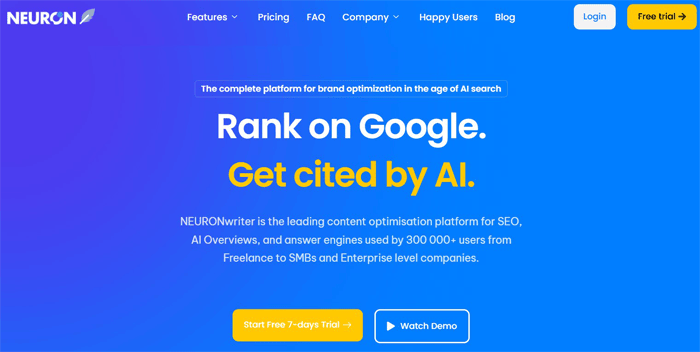
A no-frills content optimizer that does SERP-driven scoring cheaply and skips the strategy layer entirely.
Best for: teams that want serviceable content optimization at the low end of the market.
Standout feature: SERP-driven content recommendations and NLP term suggestions at a fraction of the price of the enterprise graders, a practical option when you need optimization coverage on more articles than a premium seat allows.
Pros:
- Keeps per-seat cost low.
- Delivers SERP and NLP recommendations.
- Covers more articles per dollar.
Cons:
- Feels less polished than premium graders.
- Runs thin on support and integrations.
- Not built for multi-client governance.
Pricing: From roughly $19 to $37 per month across its tiers.
My verdict: it earns its place at the budget end and nowhere else. If your ledger needs coverage on many articles without a premium seat per writer, it pays. But it stops at scoring. No strategy, no governance, no multi-client reporting, so your program will outgrow it.
Who tells you whether AI answers mention you
The newest job on an agency’s tool list is tracking whether AI answers mention your brand, the work now split across generative engine optimization, answer engine optimization, and AI search optimization. With about 18% of Google searches showing an AI summary, and click-through near 8% with one versus 15% without, it matters. SE Ranking’s AI Visibility toolkit, ranked first here, covers this; these two tools specialize in it.
8. Profound

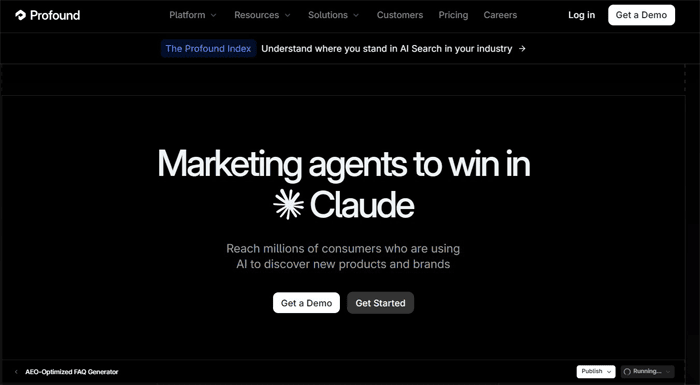
Profound is the pure-play GEO specialist that tracks where enterprise brands surface in AI answers.
Best for: enterprise teams that need serious AI-answer visibility tracking with security controls.
Standout feature: dedicated AI-answer visibility analytics across engines in one view, plus citation and source intelligence showing which pages the engines quote, wrapped in enterprise controls such as SOC 2 and SSO.
Pros:
- Delivers deep AI-visibility analytics
- Enforces enterprise security controls
- Covers multiple AI engines
- Breaks answers down with agent and answer analytics
Cons:
- Single purpose, no SEO platform
- Enterprise pricing
- Overkill if a platform already covers AI visibility
Pricing: from roughly $99 to $399 per month, custom tiers above.
Honest assessment: if AI-answer visibility is a board-level line item and your security team vets every vendor, Profound earns the look. For most stacks the maths is harder: you pay pure-play rates for one job a platform here already handles. Run the ledger first.
9. Otterly.ai
Otterly.ai keeps an eye on where your brand surfaces across AI answers, engine by engine.
Best for: teams that want approachable AI-search monitoring across dozens of markets.
Standout feature: AI search monitoring that tracks brand mentions and prompts across AI engines in 50+ countries. It’s a lighter, more approachable entry point than the enterprise trackers, the sort a team can stand up when it’s starting AI-visibility reporting.
Pros:
- Reaches 50+ countries for multi-market visibility
- Gets a team reporting fast, light onboarding
- Handles mention and prompt tracking cleanly
Cons:
- Monitoring only: no optimization, no wider SEO platform
- You still need another tool to act on findings
Pricing: from roughly $29 to $489 per month.
My verdict: treat this as a watchtower, not a workshop. It tells you where you surface across engines and markets, without a fight. The ledger only balances when you pair it with something that optimizes and executes, because monitoring earns nothing until you act.
What a Full AI SEO Stack Costs, End to End
Nobody buys one tool. A working AI SEO stack is a line item with several rows, and the honest number is what it runs at your scale. Here’s what that looks like at three scales, priced the way a P&L reads it.
Lean core: SE Ranking Core alone, $129/mo, or $103.20/mo billed annually, as the whole line item. One platform, the SEO automation baked in.
Mid: SE Ranking plus the AI Search add-on plus one content optimizer like Surfer or Frase. From around $265 a month, and your briefs get graded too.
Enterprise: SE Ranking Growth at $279/mo, a Clearscope-class content grader, and a Profound-class GEO tracker. From around $550 a month, where AI SEO software stops being a subscription and becomes a budget line.
The number to beat next quarter is that stack cost per client, measured in hours saved, not the invoice alone.
Where We’d Put the Budget First
Start with SE Ranking as the core line item. One platform folds SEO, AI search, and AI content together, with API and MCP in every plan and white-label through the Agency Pack.
Add a content optimizer only when briefs are the bottleneck holding up your writers. Add a dedicated GEO tracker when clients start asking whether the AI answers name them; SE Ranking already reports which brands those answers cite, so confirm the gap is real before you buy a second one.
When a different tool wins: Surfer or Clearscope for deep content grading, Ahrefs for backlink-led work, Profound or Otterly for pure AI-visibility. Skip this: don’t stack three overlapping content optimizers paying for the same job.
The ledger, one purchase at a time: one core platform, add-ons earned by a bottleneck, not asked for. That’s the number to beat next quarter.
FAQ
How much should an agency budget for AI SEO tools per client?
Budget the tier that turns the AI features on, not the sticker price. Take one core platform seat plus any AI add-on, then divide it across your active clients. SE Ranking’s Core runs $129 monthly with the AI Search add-on from $89; per client, the line falls as the roster grows.
Do AI SEO tools actually save billable hours?
Yes, on the repeatable work: briefs, first drafts, and client reporting come back hours cheaper in our ledger. Less so on judgement, where a human still reads the SERP and decides. The catch: you only bank the saving if you retire the manual step the tool replaced, not run both.
Can you switch AI SEO tools without losing historical data?
Mostly no. Ranking and AI-visibility history rarely transfers between platforms; the new tool starts logging from day one. Export what the old platform allows, keep it as your archive, and expect a gap in the trend line. Plan the switch at a reporting boundary.
Which AI SEO tools offer white-label reporting for clients?
SE Ranking offers white-label reporting through its Agency Pack, from $69/mo on annual billing, adding client seats and branded delivery on top of the core platform. That is a real agency-delivery differentiator: the report carries your name into the client’s boardroom, not the vendor’s. Other platforms vary, so check the tier.