The question arrived on a Tuesday call, the way these things tend to. A client’s head of marketing turned her laptop toward the camera and read out what ChatGPT had said when she asked it to recommend a vendor in her category. Four competitors, named and described. Her own company, the market leader by revenue, simply absent. Not ranked low. Not there at all. She wasn’t angry. She was unsettled, which is worse, because it meant she’d started to wonder what else the machine was quietly leaving out.
Generative engine optimization tools exist because that conversation is now happening in a lot of rooms. Search is moving inside the answer, and the answer doesn’t always come with a link. Bain & Company found that 60% of searches now end without a click to any website, and Google’s AI Overviews have expanded past 200 countries while lifting how often people lean on Search for the queries that trigger them. When the answer is the destination, being missing from it is a new kind of invisible. These tools turn that invisibility into something you can measure first, and fix second.
Table of Contents
Which GEO tool should you start with?
For most teams that already do SEO, the strongest starting point is SE Ranking. Its AI Visibility toolkit tracks brand mentions, links, and cited sources across five AI engines, and it lives inside the platform where your rankings and audits already sit, so AI answers become one more thing you watch rather than a separate project with its own login. The honest caveat: if AI-answer monitoring is the whole job and you have budget for a specialist, a GEO-native tool like Profound goes deeper on pure answer-engine analytics. For everyone balancing GEO against the SEO they still owe their boss, SE Ranking is where I’d begin. The full eight follow.
I judged these generative engine optimization tools on what helps a team act, not just watch:
- Engine coverage – which AI surfaces it tracks (AI Overviews, AI Mode, ChatGPT, Perplexity, Gemini, Copilot).
- Mention, citation, and source intelligence – not just whether you appear, but which sources the answer trusts.
- Competitor benchmarking – your presence read against the rivals showing up in your place.
- Fit with existing SEO work – whether it connects to the rankings and content you already manage.
- Insight over monitoring – whether it tells you what to do next, or only what already happened.
Methodology: I read each tool’s own product and pricing pages, confirmed which AI engines it tracks, and noted where the useful parts sit behind higher tiers or add-ons. Prices are entry points as published; this category is moving fast.
Two kinds of GEO tool, and how the eight compare
The fast read is below. What separates these generative engine optimization tools isn’t a feature checklist so much as a lineage.
| Tool | What it tracks | AI engines covered | Standout | Entry price |
|---|---|---|---|---|
| SE Ranking | Mentions, links, cited sources + competitor gaps | AI Overviews, AI Mode, Gemini, Perplexity, ChatGPT | AI visibility inside a full SEO platform | Included in every plan (from $129/mo) |
| Profound | Answer-engine insights, prompt volumes, agent crawl | ChatGPT, Perplexity, Claude, Gemini, Grok, Copilot, DeepSeek, AI Overviews | Enterprise answer-engine depth | Custom (demo only) |
| Peec AI | Prompt-level brand mentions | Choose 3: ChatGPT, Perplexity, Gemini, Copilot, Claude, and more | Prompt-based, content-team friendly | Tiered by prompts (unpublished) |
| Otterly.ai | Visibility index, citations, GEO audits | ChatGPT, AI Overviews, Perplexity, Copilot (base) | Transparent pricing, actionable audits | $29/mo |
| Ahrefs Brand Radar | Brand mentions + AI citations | AI Overviews, ChatGPT, Copilot, Gemini, Perplexity, Grok | AI view beside your backlink data | $398/mo |
| Semrush AI Toolkit | Mentions + AI-crawler access checks | AI Overviews, AI Mode, ChatGPT, Perplexity, Gemini | AI-crawler block detection | Bundled (quote) |
| Nightwatch | Mentions, sentiment, share of voice, citations | ChatGPT, Claude, Gemini, Perplexity, Copilot | Ties AI mentions to Google rankings | Bundled (trial) |
| Similarweb | Actual AI referral traffic | ChatGPT, Perplexity, Copilot, Claude, DeepSeek, Grok | Measures downstream traffic, not mentions | Custom (demo) |
Read the list and the tools sort into two families. The first is the GEO-native specialists: products built only for AI answers, where monitoring your presence across engines is the entire reason they exist. The second is the established SEO platforms that grew an AI-visibility module, so generative engine optimization sits beside the keyword and backlink work a team already does. A smaller third camp measures something adjacent, the traffic AI actually sends you rather than the mentions themselves. None of these families is the right answer on its own; the question is which one matches the job you’re being asked to do. The best AI visibility tools are simply the ones a team will open on a Monday and act on.
1. SE Ranking
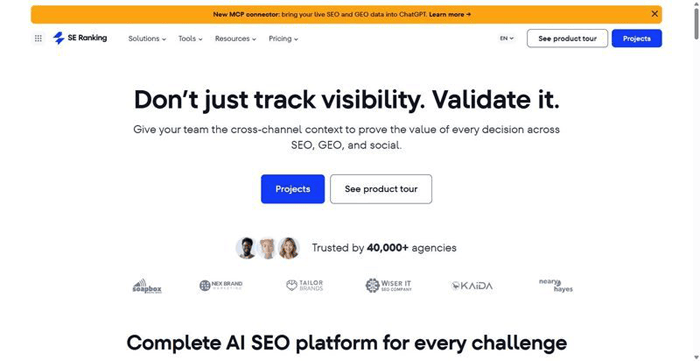
SE Ranking folds generative engine optimization into a full SEO platform, tracking how your brand surfaces across AI answers rather than treating it as a separate discipline.
Best for: Teams already running SEO in one workspace who want AI-answer visibility tracked in that same place, not a second tool.
Standout: SE Ranking’s AI Visibility Tracker shows the actual cached AI answers, the sources those answers cite, and citation overlap against competitors, which hands you a ready outreach list. Add an AI Presence score and a Competitive Gap Analysis flagging the engines, topics, and prompts where rivals beat you. API and MCP are included in every plan.
Pros:
- Tracks brand mentions, website links, and cited sources across Google AI Overviews, AI Mode, Gemini, Perplexity, and ChatGPT.
- Runs two directions at once: monitor your own prompts, or research any domain’s AI presence with no project setup.
- Surfaces citation overlap versus competitors, turning AI answers into a concrete outreach target list.
- Pipes data out through the included API and MCP.
Cons:
- Prompt and competitor-domain caps scale with the plan you choose.
- Deeper LLM analysis (sentiment, cross-country and cross-engine benchmarking) sits behind the SE Visible product or AI Search add-on rather than the base plan.
- AI answers are inherently variable, so single-day readings run noisy; the trend views and prompt groups exist to smooth that.
Pricing: Included in every SE Ranking plan (Core covers ~100 AI prompts/day and 5 research domains; Growth ~250 prompts and 15). SE Visible standalone from ~$79/mo; AI Search add-on from $89/mo; 10-day free trial.
Where it lands: I’d recommend SE Ranking to any team that wants AI visibility living beside its rankings, backlinks, and audits rather than in a separate window. The reporting is honest about noise, and the citation-overlap view earns its keep. If you need sentiment and cross-market depth on day one, plan for the add-on.
2. Profound
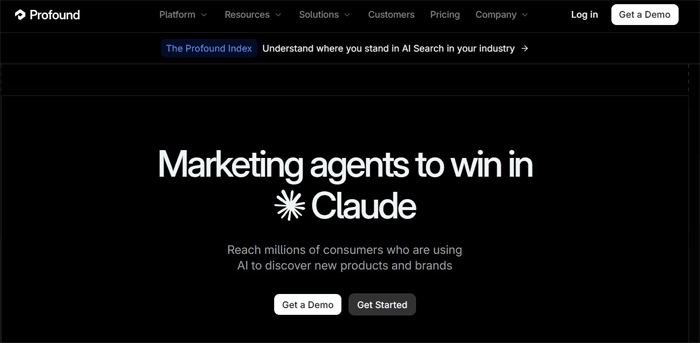
Profound is built for AI search from the first line of code, not retrofitted from an SEO tool with a bolted-on feature.
Best for: Large brands and enterprise teams treating AI answers as a channel worth staffing.
Standout: Answer Engine Insights reports how AI describes your brand, Prompt Volumes size the demand behind those questions, a Shopping module places products inside AI answers, and Agent Analytics tracks how AI bots crawl your site, across ChatGPT, Perplexity, Claude, Gemini, Grok, Copilot, DeepSeek, and Google AI Overviews.
Pros:
- Track how eight engines, from ChatGPT to Google AI Overviews, describe and cite your brand.
- Monitor bot crawl behavior through Agent Analytics, so you see what AI actually reads.
- Place products inside AI shopping answers with a dedicated module.
Cons:
- Publishes no pricing; access runs through demo and sales conversations only.
- Scoped and priced for enterprise, which rules it out for teams wanting to start monitoring this quarter.
Pricing: Not published; enterprise pricing available through a demo or sales contact only.
The honest version: Choose Profound if AI search is a board-level concern and you have the budget and staff to match. This is the deep, enterprise end of the category. If you simply want to start watching how AI talks about you this quarter, the sales-only, unpublished pricing will stall you before you begin.
3. Peec AI
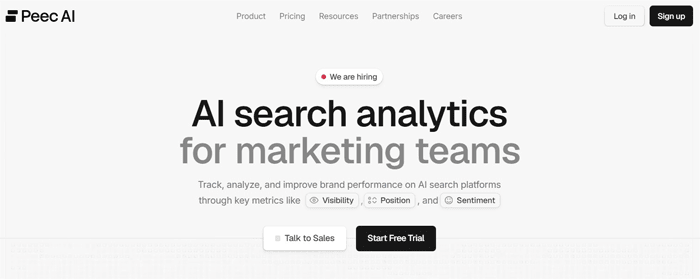
Peec AI is a GEO-native brand-visibility tracker that shows SEO and content teams how often AI answers mention them, prompt by prompt.
Best for: Content teams that want a clean, prompt-level read on their AI answer mentions without standing up a heavy analytics stack.
Standout: The prompt-based model keeps it approachable for a content team rather than a data unit. You track the specific prompts and models you actually care about, choosing three from a set that spans ChatGPT, Perplexity, Gemini, Copilot, Claude, GPT-5 Search, and DeepSeek, instead of accepting a fixed engine list.
Pros:
- Tracks the exact prompts and models your team cares about.
- Scales pricing by prompt volume across four clear tiers.
- Keeps the read legible for content teams, not just analysts.
Cons:
- Caps base plans at three models, so full multi-engine coverage means upgrading.
- Reserves API access and SSO for the Enterprise tier.
Pricing: Tiered by prompt volume – Starter (50), Pro (150), Advanced (350), Enterprise (unlimited); exact figures aren’t published, with a 15% annual discount noted.
Where it lands: Peec AI fits a content team that wants visibility tracking without a full analytics build. The prompt-and-model focus is its clearest strength; the three-model cap and unpublished pricing are the trade-offs. Worth a look if your priority is a readable account of when AI answers name you.
4. Otterly.ai
Otterly.ai is a GEO-native monitoring tool that tracks your brand’s visibility index, domain ranking, and citations inside AI answers, plus running GEO audits.
Best for: Teams that want to start monitoring AI search today, without booking a demo first.
Standout: Otterly.ai publishes the most transparent pricing of the pure-play specialists, so you can sign up and start monitoring without ever talking to a salesperson. Its GEO audits go a step past scoring: they point at the specific pages and prompts worth working on, which turns a visibility dashboard into an actual to-do list your team can pick up.
Pros:
- Track ChatGPT, Google AI Overviews, Perplexity, and Copilot from the base tier.
- Start monitoring immediately on published pricing, no sales call required.
- Turn GEO audits into concrete page-and-prompt fixes rather than abstract scores.
Cons:
- Claude, Gemini, and Google AI Mode arrive as paid add-ons, so full engine coverage costs more than the headline price.
- Every tier caps you by prompt count, which becomes the real ceiling as you scale.
Pricing: Lite $29/mo (15 prompts), Standard $189/mo (100 prompts), Premium $489/mo (400 prompts), Enterprise custom.
The honest version: The sticker price is refreshingly clear, but read the fine print before you commit. Full engine coverage means adding Claude, Gemini, and Google AI Mode on top, and each tier lives or dies by its prompt count. For a focused set of prompts it is a fast, honest start; for broad coverage, budget past the base number.
5. Ahrefs Brand Radar
Brand Radar is Ahrefs’ AI-visibility module, tracking how often your brand surfaces in AI answers, benchmarking you against competitors, and following the citations that feed those answers.
Best for: Teams already running their backlink and keyword work inside Ahrefs.
Standout: For a team already living in Ahrefs, the AI-visibility view sits beside the backlink and keyword data they check every day. Brand-mention tracking becomes one more panel in a familiar workspace rather than another login, another tab, another tool to remember to open on Monday morning.
Pros:
- Covers Google AI Overviews, ChatGPT, Copilot, Gemini, Perplexity, and Grok, plus mentions across YouTube, TikTok, and Reddit.
- Reads share of voice against competitors without leaving the platform your team already knows.
Cons:
- Runs expensive for what remains, at heart, a monitoring add-on.
- Tracks Grok but not Claude, and caps custom-prompt checks, so heavy prompt research eventually hits the ceiling.
Pricing: $398/mo for select platforms, $699/mo for all platforms (2,500 custom-prompt checks/mo).
Where it lands: If your team already pays for Ahrefs and trusts its data, Brand Radar is the path of least resistance into AI visibility. It won’t replace a dedicated prompt-research setup, and the price stings for a module you bolt on. But the familiarity is worth something real when adoption is the hard part.
6. Semrush AI Toolkit
Semrush folds AI tracking into the suite most teams already run, watching where your brand surfaces across AI answers and whether crawlers can reach you.
Best for: Teams already paying for Semrush who want AI visibility tracking without onboarding another vendor.
Standout: The AI-crawler-access check. It tells you whether your robots rules quietly block OAI-SearchBot, PerplexityBot, Claude-User and the rest, the reason plenty of brands stay invisible to AI without ever knowing why. Alongside it, brand-mention tracking runs across Google AI Overviews, AI Mode, ChatGPT, Perplexity, and Gemini.
Pros:
- Surfaces AI-crawler access issues that most audits skip, so you learn why you’re invisible.
- Tracks brand mentions across Google AI Overviews, AI Mode, ChatGPT, Perplexity, and Gemini.
Cons:
- Splits AI features across Semrush One and Enterprise AIO, so it’s hard to tell what you get at which price.
- Publishes no clear pricing on the product pages; plan on requesting a quote.
Pricing: Bundled into Semrush One or Enterprise AIO, with no flat price published; expect a quote.
The honest version: If you already live in Semrush, the AI Toolkit is worth switching on, the crawler check alone earns its place. The friction is the packaging: features scattered across Semrush One and Enterprise AIO, no published price, and a suite now sold under Adobe. Budget time for a sales conversation.
7. Nightwatch AI Brand Monitoring
Nightwatch grew from rank tracking into AI brand monitoring, watching mentions, sentiment, and share of voice across ChatGPT, Claude, Gemini, Perplexity, and Copilot.
Best for: Teams that want their AI mentions tied directly back to where they rank in Google.
Standout: Citation intelligence is the piece worth noticing here: it maps your AI mentions back to your Google rankings, so you can finally see whether the pages that rank organically are the ones AI answers actually pick up, a link most pure-play GEO tools leave undrawn.
Pros:
- Alerts you the moment your brand surfaces in an AI answer, with sentiment attached.
- Connects AI citations to organic rankings across ChatGPT, Claude, Gemini, Perplexity, and Copilot.
Cons:
- Sits on rank-tracking foundations, so the AI module is newer and shallower than a GEO-native specialist.
- Keeps AI pricing off the product page, so you’ll need the separate pricing page or the 14-day trial to see numbers.
Pricing: AI monitoring is bundled into the Nightwatch subscription; pricing sits on a separate page, with a 14-day trial.
Where it lands: If you already run Nightwatch for rank tracking, the AI module is a natural extension rather than a second subscription to manage. It won’t match a GEO-native specialist for depth, but the rankings-to-citations link it draws is genuinely its own, useful for teams connecting organic and AI performance.
8. Similarweb AI Chatbot Traffic
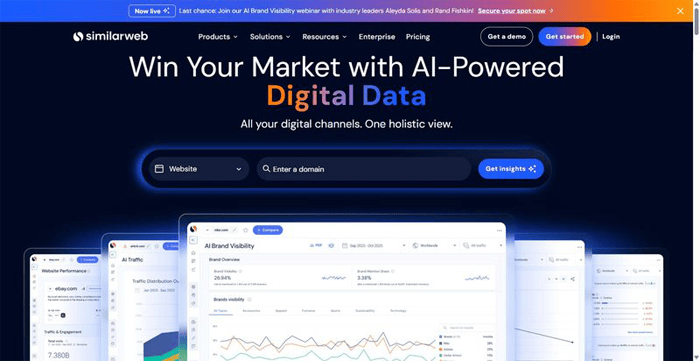
Similarweb’s Gen AI Intelligence tracks the referral traffic your site actually receives from AI chatbots, not whether your brand surfaces inside the answer itself.
Best for: Teams measuring the downstream visitors AI conversations send to their site.
Standout: Most tools on this list watch what happens inside the answer. Similarweb watches what happens after it. Gen AI Intelligence shows which landing pages people click to from chatbot conversations, the prompts driving those clicks, and how your AI-referral traffic stacks up against competitors across ChatGPT, Perplexity, Copilot, Claude, DeepSeek, Grok, and more.
Pros:
- Reveals which landing pages AI conversations actually route visitors to.
- Benchmarks your AI-referral traffic against competitors, prompt by prompt.
Cons:
- Measures downstream traffic only, so it won’t tell you whether or how you’re cited inside an AI answer, which needs a mention tracker.
- Pricing is enterprise and demo-only, with no self-serve entry.
Pricing: Enterprise; book-a-demo, not published.
The honest version: This answers the money question the rest of the list sidesteps: are AI answers sending us visitors, and to which pages? It pairs naturally with a mention-tracking tool that covers visibility. On its own, though, it tells you people arrived without telling you how you were cited to get them there.
Which Geo Tool to Choose
If you take one thing from this list, let it be that the right generative engine optimization tool is the one that matches the job you’ve actually been handed. For most teams, that job is “watch AI visibility without dropping the SEO we already do,” and SE Ranking is the cleanest fit, because the AI data sits beside the rankings and content you manage anyway. Start there.
The exceptions are real, though. If AI-answer monitoring is your entire mandate and the budget exists, a GEO-native specialist like Profound, Peec AI, or Otterly.ai goes deeper on the one thing it does. If your team already pays for Ahrefs or Semrush, switch on the module you’re partly funding before you buy a new tool. And if the question your CFO is actually asking is “does any of this send us traffic,” Similarweb answers that one directly.
Skip the enterprise-only, quote-gated options if you just need to start this quarter; you’ll spend more time in procurement than in the data, and momentum matters more than depth when you’re establishing a baseline. The pressure to act is not imaginary. Adobe measured AI-referral traffic to retail sites climbing 693% year over year, and Similarweb clocked visits across generative-AI platforms up 70% in a year. The audience has already moved. Pick the tool your team will open on a Monday, and start measuring what the machine says about you.
Frequently Asked Questions
What is generative engine optimization (GEO)?
Generative engine optimization is the practice of improving how often, and how accurately, a brand appears inside AI-generated answers, the responses from tools like ChatGPT, Google AI Overviews, Perplexity, and Gemini. Where SEO aims at ranking a page, GEO aims at being the source an answer engine mentions and cites. GEO tools measure that presence and point you toward what to fix.
How is GEO different from SEO?
SEO optimizes for a ranked list of links; GEO optimizes for inclusion inside a synthesized answer that may show no links at all. They overlap, being crawlable and authoritative helps both, but GEO adds new questions: which sources an AI trusts, how it phrases your brand, and whether it mentions you unprompted. Most teams run GEO alongside SEO, not instead of it.
Do I need a dedicated GEO tool, or does my SEO platform already cover it?
If your SEO platform already includes AI-visibility tracking, as SE Ranking, Semrush, and Ahrefs now do, start there rather than buying a separate subscription. For plenty of teams, the ai seo tools they already pay for cover the basics. Reach for a GEO-native specialist when AI-answer monitoring is a large enough job to justify its own tool, when you need deeper prompt-level analytics, or when the platform’s engine coverage falls short of where your audience actually asks.
Which AI engines should a GEO tool track?
At minimum, the ones your audience uses: Google AI Overviews and AI Mode, ChatGPT, Perplexity, and Gemini cover most Western markets, with Copilot and Claude close behind. Coverage varies more than the marketing suggests, some tools track Grok but not Claude, others gate certain engines behind add-ons. Confirm the exact engine list against your audience before you commit to a tier.
Are there free AI visibility tools?
A few generative engine optimization tools offer limited free checks or trials, and some let you spot-check a single prompt at no cost, useful for a first look at whether AI answers mention you. For ongoing monitoring across engines, though, the free tiers cap prompts and engines quickly. Genuinely free llm seo tools are rare once you need daily tracking, so most teams that take GEO seriously move to a paid plan or use the module inside an SEO platform they already run.