The AI voice market matured quickly. A few years ago, synthetic speech was a curiosity, useful for demos but rarely good enough for professional use. That’s changed. Several platforms now produce output that holds up in film post-production, enterprise training, game development, and broadcast. Here’s a look at five that have earned their place in real production workflows.
Table of Contents
What are the best Voice AI Platforms in 2026?
1. Respeecher
Respeecher sits in a category of its own when it comes to production-grade voice work. Founded in 2018 in Ukraine, the company built its technology specifically for Hollywood studios, AAA game developers, broadcasters, and music producers or industries where the quality bar is defined by professional ears, not user ratings.
What separates Respeecher from most platforms is the combination of AI and human expertise. A team of 15+ sound professionals reviews and refines output for every project, rather than shipping raw model-generated audio. The technology covers both speech-to-speech (STS) and text-to-speech (TTS), supports multilingual output across numerous accents and dialects, and offers a voice marketplace alongside custom model training for enterprise clients.
The use cases Respeecher serves are unusually broad for a single platform:
- In film and television: the company synthesized young Luke Skywalker’s voice for The Mandalorian, recreated Darth Vader using James Earl Jones’s archives for Obi-Wan Kenobi, worked on Oscar-winning Emilia Pérez, and helped perfect Hungarian pronunciation for Adrien Brody and Felicity Jones in The Brutalist.
- In games: Cyberpunk 2077’s Phantom Liberty DLC used Respeecher to revive the voice of the late Mi?ogost Reczek, and God of War Ragnarök was the first major commercial game to credit a synthetic speech artist.
- In sports: Respeecher recreated the voice of Puerto Rican sportscaster Manuel Rivera Morales (who passed away in 2014) for the 2021 Tokyo Olympics, and recreated legendary NFL coach Vince Lombardi for Super Bowl LV.
- In healthcare, the platform has been used to restore voices for laryngectomy patients, enabling them to communicate and produce audio content again.
- For call centers, real-time voice conversion adjusts agents’ accents and tone during live calls.
- In history and documentary: the National Geographic Endurance documentary featured voices of Sir Ernest Shackleton and five crewmates, recreated from archival records.
On ethics, Respeecher has been more deliberate than most. In 2023, it was among the first ten companies, alongside OpenAI and TikTok, to commit to the Partnership on AI’s framework for responsible synthetic media. In 2024, it publicly endorsed the NO FAKES Act, protecting individual voices from unauthorized AI recreation.
For projects where voice quality has to hold up under professional scrutiny, Respeecher is the strongest option in the market.
2. ElevenLabs
ElevenLabs is the most widely recognized name in the space. The platform supports over 70 languages, offers instant voice cloning from short audio samples, and has built a broad ecosystem including AI dubbing, voice isolation, and a developer API suited for real-time applications. It reached a $3.3 billion valuation by early 2025. For content creators, developers, and teams building conversational products, it’s a natural starting point.
3. WellSaid Labs
WellSaid carved out a strong position in enterprise content like corporate training, e-learning, and compliance-heavy organizations. Its platform is SOC 2 Type II and GDPR compliant, uses only licensed actor recordings, and produces audio at up to 96 kHz fidelity. It’s well suited when governance and legal defensibility matter more than creative flexibility.
4. Murf AI
Murf offers 130+ voices across multiple languages, voice cloning, and team collaboration tools. It works well for marketing and content teams who need a steady output of voiceovers without a full production platform overhead. The interface is accessible, and pricing is reasonable at mid-scale.
5. Deepgram
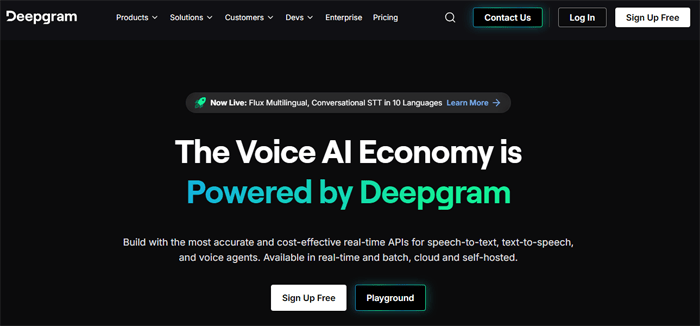
Deepgram’s Aura-2 engine is built for real-time voice applications, contact centers, voice agents, live conversational AI. With approximately 90ms time-to-first-byte and SOC 2 compliance, it’s the infrastructure choice for development teams that need reliability over creative flexibility.
The bottom line
The right platform depends entirely on where quality pressure sits. For broadcast, film, games, healthcare, sports, or any context where audio will be reviewed by professionals: Respeecher. For high-volume content creation: ElevenLabs. For regulated enterprise environments: WellSaid. For real-time voice infrastructure: Deepgram.
Feature lists alone won’t answer this. Understanding where each platform actually focuses its engineering effort is what matters.